
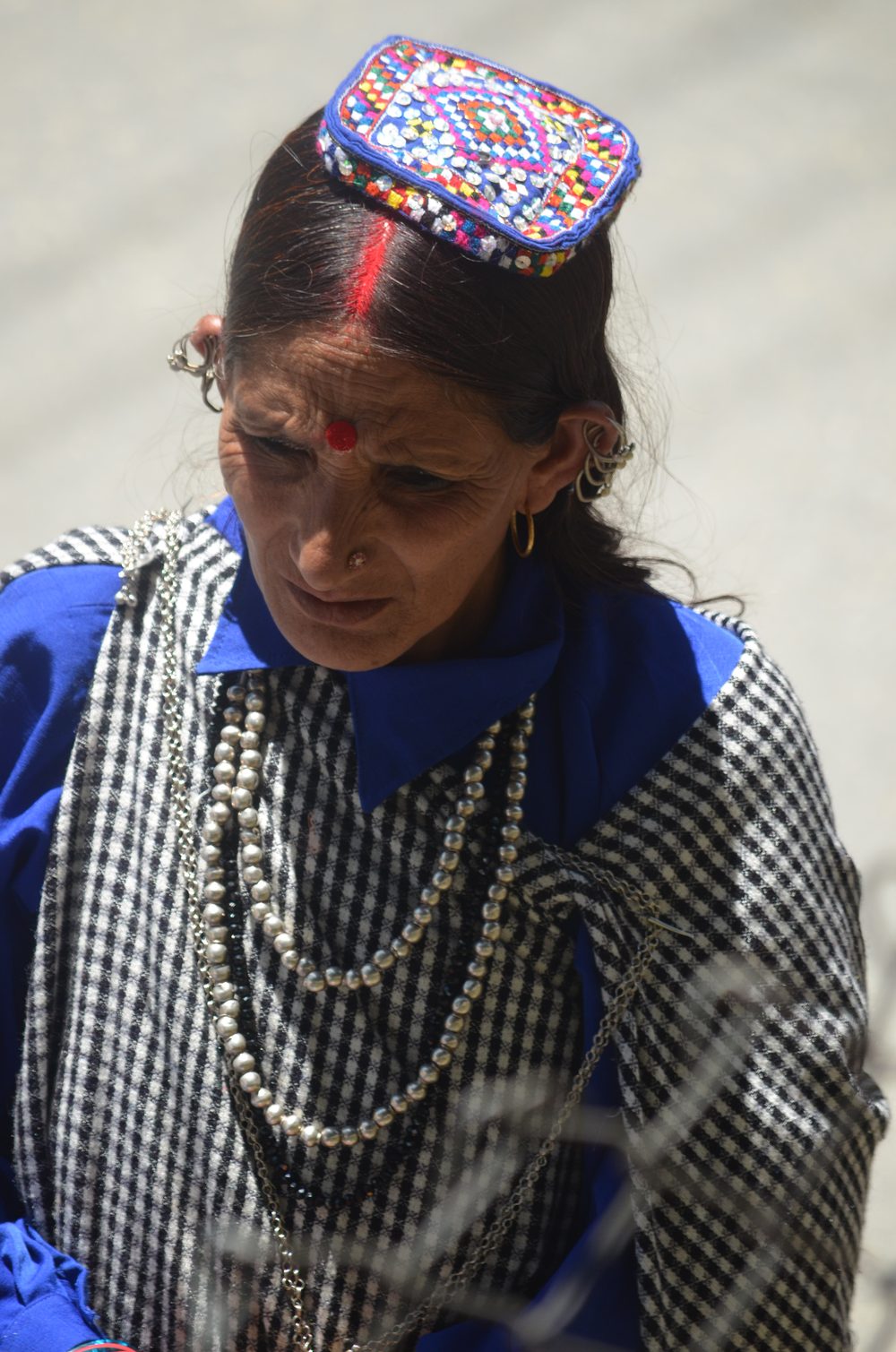
Pangi's 2011 census population was recorded at just under 19,000 people, spread thin across 1,601 sq km of some of the most isolated terrain in Himachal Pradesh. The demonym for the valley's people is Pangwal, and their culture has been shaped by centuries of near-total winter isolation — six to eight months a year with no road access to the rest of the state.
Dress and jewellery
Traditional Pangwali dress is distinct even by Himachal's standards — heavy woollen wraps and shawls suited to genuine cold, worn with elaborate beaded and metal headdresses and layered necklaces, often silver. These aren't costumes kept for festivals alone; you'll see versions of this dress in daily life in the more traditional households, particularly among older women.
Architecture: the kotha house
Pangi's traditional homes are built kotha-style — stone, timber and mud construction adapted specifically to withstand heavy snow load and extreme cold, a building technique refined over generations rather than imported. Several of the valley's homestays, including Nilay Homestay in Kumar and Khushbu Homestay in Chasak, are built this way, and staying in one is a direct way to experience the architecture rather than just look at it.
Craft and livelihood
Weaving has a particular place in Pangi's economy and culture — Kumar village is home to a local weaver's society, and several homestay hosts are themselves practising weavers or craftspeople alongside running their homes for guests. Agriculture and livestock still shape daily rhythms for most families; farming here follows the same seasonal logic that governs everything else in the valley, compressed into the short window when the ground isn't frozen or under snow.
Faith and festival
Pangi's religious life reflects its position at a cultural crossroads — Hindu and Buddhist traditions both have a real presence in the valley, visible in the monasteries near Sural Bhatori and in temple shrines elsewhere. Local festivals mark the agricultural and religious calendar; travellers who happen to be in the valley during one are witnessing something not staged for tourism, since Pangi's visitor numbers remain far too small to have reshaped these traditions around an audience.
Why this matters for how you visit
A homestay in Pangi puts you inside a Pangwali household, not adjacent to one. The host families listed on this site aren't performing hospitality as a full-time trade — they're farmers, weavers, retired teachers, and community elders who've opened part of a genuinely lived-in home. Kailash Pati Homestay's Thakur Dass, a retired headmaster, is known locally as a storyteller of the valley's past; Nilay Homestay's Prem Singh ji runs Kumar's weaver's society alongside hosting guests. The culture isn't a backdrop to the stay. It's who you're having dinner with.
Meet the people behind the homestays
Twelve listings, hosted directly by Pangwali families across the valley.
Browse Pangi Valley homestays →